

The government mentioned it’s deploying synthetic intelligence-assisted equipment and virtual audit trails within the Nigeria Immigration Carrier (NIS) to fortify border safety, locate suspicious migration patterns and grasp officials in command of their selections, as a part of efforts to near knowledge gaps exploited by means of criminals.
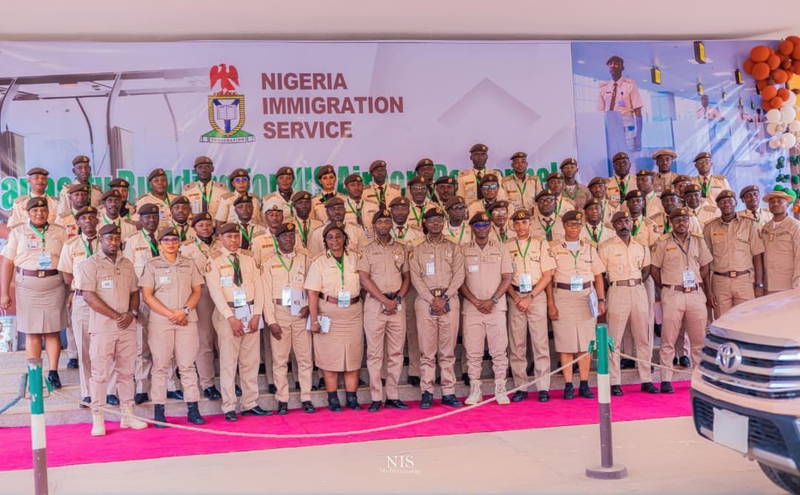
The Minister of Inside, Olubunmi Tunji-Ojo, disclosed this on Friday on the final rite of a specialized coaching programme on border keep an eye on and immigration control on the NIS headquarters in Abuja, the place he defined the federal government’s efforts to modernise immigration operations and fortify coordination amongst businesses accountable for nationwide safety.
Tunji-Ojo mentioned the immigration reforms shaped a part of a broader governance initiative to attach knowledge techniques throughout businesses beneath the ministry and cut back safety vulnerabilities created by means of disconnected databases.
He mentioned the federal government had advanced a 10-year expertise roadmap and established a knowledge centre with a capability exceeding 8 petabytes, supported by means of a sun farm that permits the information command and keep an eye on centre to perform off-grid.
Consistent with the minister, the broader Centralised Inside Control and Management Device (CMAS) was once designed to combine related knowledge techniques around the ministry, together with correctional and hearth carrier management platforms, whilst making improvements to coordination with id control establishments.
He argued that managing migration in a rustic with greater than 200 million other people thru analogue processes was once now not sustainable, in particular when government wanted dependable details about the identities and standing of other people getting into, leaving or living in Nigeria.
Tunji-Ojo puzzled authentic data that reportedly put the choice of international nationals running within the nation at about 40,000 when he assumed workplace, arguing that the determine illustrated the desire for extra complete knowledge and more potent coordination amongst executive businesses.
“We were given right into a gadget the place, by means of authentic data, we had possibly about 40,000 foreigners or no matter running in Nigeria. In a rustic of 200 million, that’s not conceivable any place on the planet,” he mentioned.
The minister puzzled how government may just successfully track international nationals and organize their affairs with out dependable details about their presence within the nation.
“While you should not have the information of the ones foreigners living for your nation, then how do you organize their affairs? How do you track them? How do you track somebody that you just don’t even know exists?” he requested.
He mentioned the federal government was once addressing the weaknesses thru knowledge harmonisation and technology-driven reforms meant to support coordination amongst businesses accountable for migration control, id verification and nationwide safety.
Tunji-Ojo additionally cited the Sept. 11, 2001 assaults in the US as a caution concerning the safety penalties of intelligence failing to achieve related government as a result of gaps in knowledge sharing.
He mentioned the management of President Bola Tinubu was once running to deal with such vulnerabilities ahead of they contributed to main safety screw ups, stressing the significance of connecting businesses that generate and procedure important knowledge.
The initiative comes because the Nigeria Immigration Carrier has consolidated greater than 15 million migration data into its Border Keep watch over and Immigration Control Device (BCIMS), integrating knowledge up to now held throughout separate platforms to support id verification, border exams and the review of attainable safety dangers.
The mixing of BCIMS with the Migration Knowledge and Information Research Device (MIDAS) is meant to offer accredited officials with a extra coordinated image of travellers’ identities, actions and attainable dangers, enabling extra knowledgeable operational selections.
The reforms are anticipated to fortify efforts to spot suspicious migration patterns and deal with id fraud, migrant smuggling, trafficking in individuals and different transnational crimes that exploit weaknesses in knowledge sharing amongst executive establishments and border instructions.
.Tunji-Ojo additionally warned expertise distributors in opposition to withholding technical wisdom from executive staff, mentioning that the ministry would prioritise wisdom switch to scale back dependence on exterior contractors.
He mentioned the federal government sought after Nigerian staff to obtain the experience required to perform and handle important techniques as a substitute of leaving public establishments inclined when distributors had been unavailable or unwilling to offer give a boost to.
“The technology when any seller will grasp the carrier of presidency to ransom is long past,” he mentioned.
“If you can not switch wisdom, then you haven’t any industry in executive industry.”
The minister mentioned the initiative was once meant to construct an immigration carrier in a position to growing native experience and sooner or later helping different international locations with border control and migration expertise.
He pledged endured funding in coaching, arguing that advanced efficiency may just no longer somewhat be demanded from officials who had no longer won the vital technical preparation.
Tunji-Ojo maintained that the federal government’s expertise investments had been a part of a broader effort to modernise public establishments, fortify interior safety and determine techniques in a position to turning in effects past the tenure of particular person officeholders.
He recommended immigration officials to translate their coaching into measurable enhancements at their accountability posts, whilst Nandap stressed out that the credibility of the reforms would in the long run rely on how responsibly the expertise was once used.
The central problem, she mentioned, was once to fortify Nigeria’s safety, facilitate respectable motion and be sure that border keep an eye on selections had been supported by means of dependable knowledge, skilled judgement and recognize for travellers’ rights.
With greater than 15 million migration data consolidated right into a centralised platform, the federal government is looking for to turn into border control from fragmented, in large part reactive operations right into a coordinated, intelligence-supported gadget.
The long-term good fortune of the initiative relies on the accuracy of the data, the reliability of the expertise, the competence of skilled officials and the effectiveness of safeguards in opposition to misuse of delicate knowledge.
Talking at the importance of the gadget, the Comptroller-Normal of Immigration, Kemi Nandap, mentioned officials’ actions at the platform may well be reviewed thru virtual data, making them extra in command of their movements and selections.
She warned that get right of entry to to the gadget should no longer be abused, stressing that officials had a accountability to offer protection to delicate knowledge and agree to established procedures.
“Your get right of entry to to the program is a place of agree with, no longer a non-public privilege,” she mentioned.
Nandap cautioned officials in opposition to sharing login credentials, gaining access to data with out authorisation or manipulating the platform to grant favours, settle private disputes or facilitate wrong passage, caution that such habits may just draw in investigation and sanctions.
“Fragmented data, remoted selections and old-fashioned strategies can not meet those calls for,” she mentioned, including that efficient migration control required attached knowledge, competent staff and responsible management.
The carrier may be deploying protected cell units to increase verification past fastened immigration terminals, permitting officials to habits exams within the box whilst keeping up confidentiality and knowledge safety requirements.
Nandap cautioned that mobility should no longer weaken safety procedures, insisting that officials should practice the similar safeguards to hand held units as they do to office-based techniques.
She mentioned synthetic intelligence-assisted equipment would assist determine patterns requiring additional exam however should no longer be allowed to make ultimate selections independently.
“No expertise is infallible. Deficient knowledge produces deficient research. Unchecked signals purpose hurt,” she mentioned.
The Comptroller-Normal known accuracy, integrity, judgement, readiness and duty as 5 non-negotiable requirements for the 87 officials who finished the specialized coaching.
Below those requirements, officials are anticipated to be sure that entries into the gadget are correct, right kind mistakes simplest thru authorized procedures, offer protection to their get right of entry to credentials, handle assigned apparatus and escalate suspicious instances thru established channels.
She additionally charged supervisors to be sure that skilled officials had been correctly deployed, apparatus remained operational and operational experiences had been submitted as required.
Nandap mentioned the good fortune of the programme can be measured by means of its affect on precise border operations relatively than the choice of officials skilled or units dispensed.
She known advanced report accuracy, constant border exams, steered escalation of signals, dependable gadget availability and the lawful remedy of travellers as key signs for assessing the reforms.
We’ve were given the brink. Get real-time experiences, breaking scoops, and unique angles delivered immediately on your telephone. Don’t accept stale information. Sign up for LEADERSHIP NEWS on WhatsApp for twenty-four/7 updates →