

Nvidia (NVDA) inventory value has taken a hit, remaining 1.29% (2.96 issues) decrease on Monday, October 12, 2026. The inventory has fallen through an extra 0.87% (1.97 issues) within the after-market hours. Nvidia’s (NVDA) newest inventory value dip comes after Microsoft (MSFT) printed its newest AI chip, the Azure Maia 300. The transfer goals to scale back Microsoft’s reliance on Nvidia (NVDA) and Complicated Micro Units, Inc (AMD).
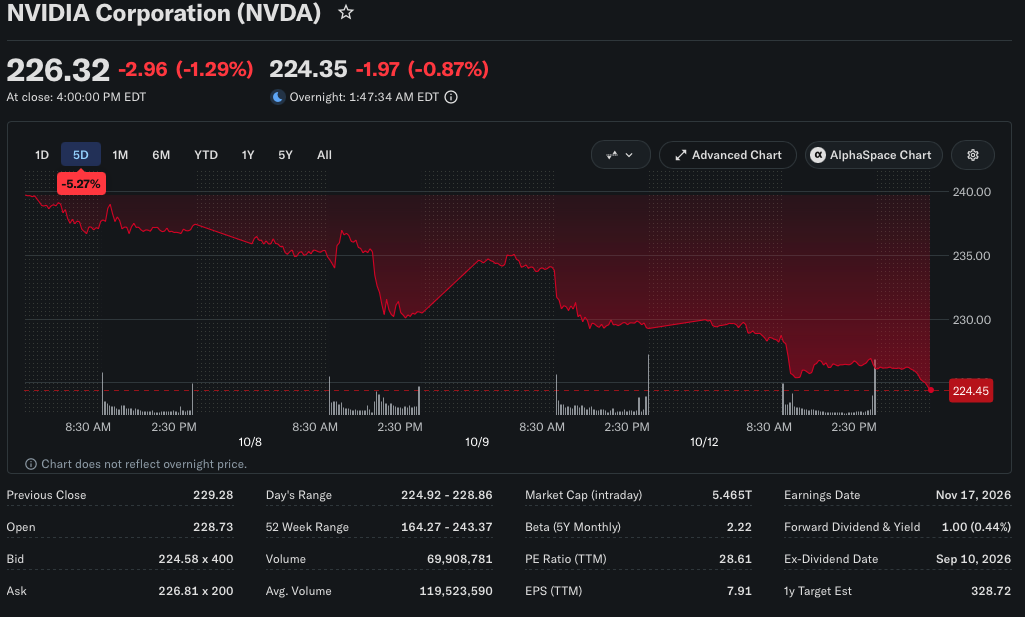
Nvidia Inventory Worth Dip: Will Microsoft’s AI Chip Additional Pull NVDA Down?

Except Nvidia (NVDA), AMD stocks costs have additionally taken a success. AMD inventory closed 2.28% decrease on Monday, and an extra 1.46% within the after-market hours. Microsoft (MSFT), then again, noticed a acquire, remaining 1.14% upper on Monday and a nil.18% acquire within the after-market hours.
The associated fee actions are perhaps because of Microsoft’s newest AI chip revelation. The corporate was once thus far depending on Nvidia and AMD chips. With its Azure Maia 300 processor, Microsoft may doubtlessly transform self-reliant. This type of transfer can be a large blow to Nvidia and AMD.
Microsoft additional stated that Maia 300 supplies 40% extra tokens in line with megawatt than different GPU-based programs. Extra tokens in line with megawatt will result in a extra environment friendly AI rack. The Maia 200 chip lately powers its Microsoft manufacturing workloads, together with Microsoft 365 Copilot. It additionally powers OpenAI fashions, Microsoft’s MAI fashions, and a number of other different open-source fashions. The rising record of fashions below Microsoft’s belt may put up a risk to Nvidia’s dominance. Different corporations may additionally observe Microsoft’s trail and cut back their reliance at the present business giants.
Additionally Learn: Stock Market Crash Warning as Valuations Echo the Dot-Com Bubble
However, Nvidia and AMD proceed to play a significant position within the knowledge heart and AI chip industry. Wall Boulevard stays bullish on each corporations, anticipating prime revenues and profits in line with proportion.