

The All Progressives Congress (APC) has told ministers, political appointees and members of its presidential campaign council to attend campaign rallies only in their own home states. The instruction is contained in a circular dated 3 November 2026 and signed by Senator Abdulaziz Yari Abubakar, the Director-General of the APC Presidential Campaign Council (PCC). It comes as the party’s 2027 campaign spreads across the country, and as local rivalries, such as those in Benue, remain in the headlines. For a closer look at one of those rivalries, read our report on the 160 candidates jostling for governorship seats in 11 states.
Key points at a glance
- The circular is titled “Guidelines on Participation at Campaign Rallies” and is addressed to all directors and heads of directorates.
- Ministers and other political appointees must attend only rallies held in their home states.
- Members of the Presidential Campaign Council must do the same.
- Most members of the APC National Working Committee (NWC) must focus on party duties in their states and zones, but five national officers are exempt.
- The council also wants more visibility for the party’s State Assembly, House of Representatives and Senatorial candidates at rallies.
What the circular says
The document is on the letterhead of the “2027 APC Presidential Campaign Council, Office of the Director-General,” with its address given as the campaign headquarters in Abuja. It carries the reference number APC/PCC/DG/XXVI X/23.
It opens by saying that, as the council steps up its activities across states and geopolitical zones, the guidelines are issued “for strict compliance.” It then lists its main points in numbered paragraphs.
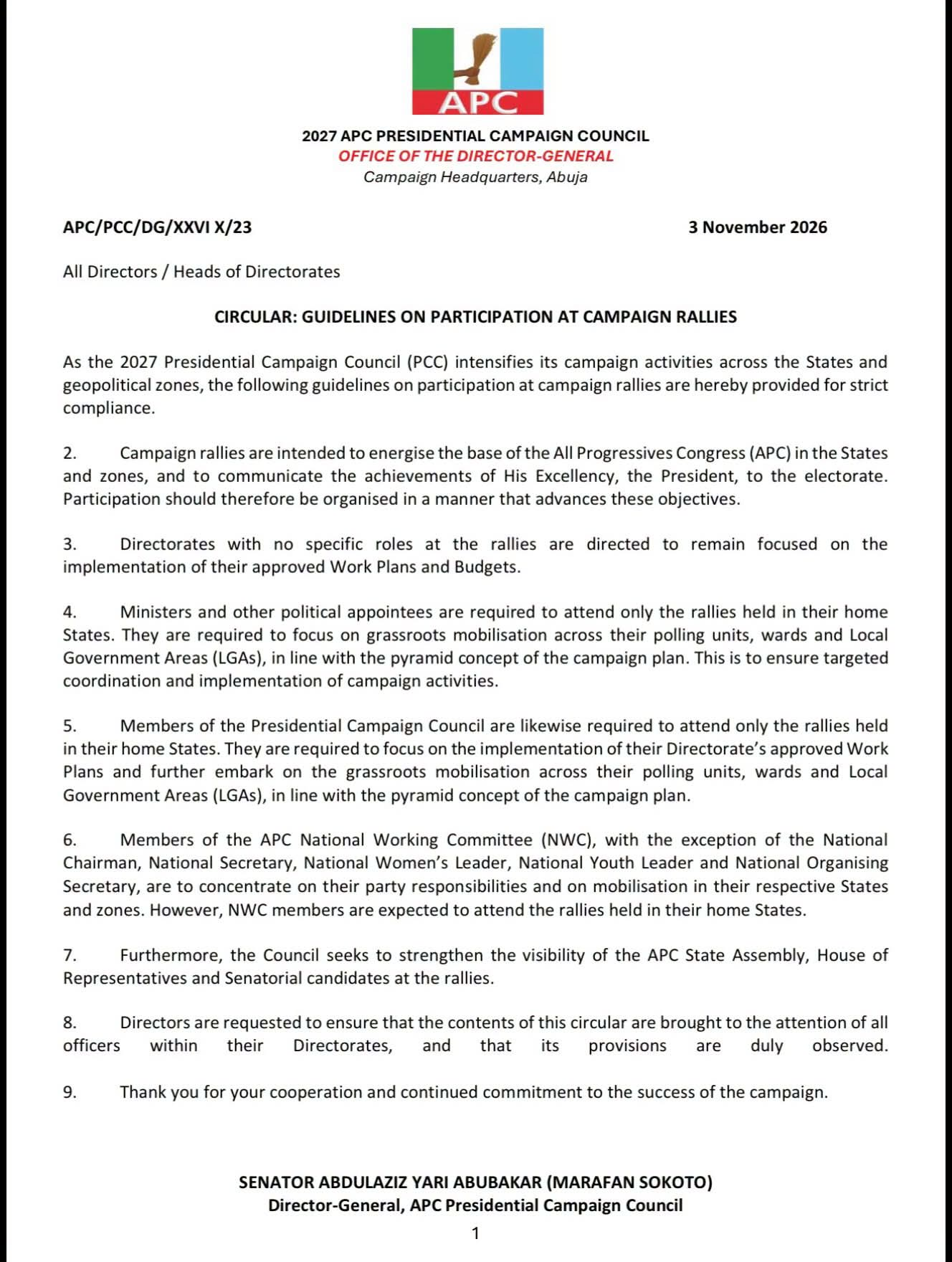
Purpose of rallies. The council says rallies are meant to energise the party’s base in the states and zones and to tell voters about the achievements of the President. It adds that participation should be organised in a way that advances those goals.
Directorates. Directorates that have no specific role at the rallies are told to keep working on their approved work plans and budgets.
Ministers and political appointees. These officials must attend only rallies held in their home states. The circular says they should concentrate on grassroots mobilisation in their polling units, wards and Local Government Areas (LGAs). It links this to what it calls the “pyramid concept” of the campaign plan, and says the aim is targeted coordination.
Members of the Presidential Campaign Council. They are also required to attend only the rallies in their home states. They are asked to carry out their directorate’s work plans and to mobilise at the grassroots, again following the pyramid concept.
National Working Committee. Members of the APC’s NWC are asked to concentrate on party responsibilities and on mobilisation in their own states and zones. However, they are expected to attend rallies in their home states. Five officers are exempt from this limit: the National Chairman, the National Secretary, the National Women’s Leader, the National Youth Leader and the National Organising Secretary.
Candidates. The council says it wants to strengthen the visibility of the APC’s State Assembly, House of Representatives and Senatorial candidates at the rallies.
Circulation. Directors are asked to bring the contents to the attention of every officer in their directorates and to make sure the rules are observed.
The circular ends with a short note thanking staff for their cooperation and commitment to the success of the campaign.
Why the rule matters
The circular does not give a long explanation for the new rule beyond the aims it states. But its wording points to how the party wants its campaign to work.
The “pyramid concept” suggests a campaign built from the bottom up. Polling units form the base, wards sit above them and LGAs above those. By asking senior officials to work in the places where they have the most influence, the party appears to want them to build support among voters they know, rather than travelling to every major event.
There is also a practical side. Rallies draw large numbers of officials, and a limit on who attends can reduce crowding on stages and cut travel costs. It may also make sure that senior figures are present where local voters know them best.
For readers following how supporters organise behind the President, our report on how BTO4PBAT is rallying Ondo youths for Tinubu shows another side of the grassroots effort.
How this fits the wider campaign plan
The circular follows the party’s release of a nationwide rally schedule. According to ThisDay, the schedule covers all 36 states and the Federal Capital Territory, and runs from October 2026 to early January 2027. The President is expected to lead rallies in 12 states, with a closing rally in Lagos on 9 January 2027.
The same report lists several dates, including Plateau on 14 November, Ibadan on 21 November, Sokoto on 5 December and Asaba on 12 December. Zikoko noted that, at the campaign council’s inauguration on 14 October, the President said his duties as head of state would require him to stay focused on governance during the election period. Party officials are expected to lead events in the states he does not visit, according to Zikoko.
Put together, the two documents describe a division of labour. The President appears in a limited number of states, and the party’s officials carry the campaign in the rest. The new circular helps define who carries it, and where.
What the party’s critics and supporters may say
As of this report, the party has not published a detailed explanation of the circular beyond its text. Reactions from the opposition and from within the APC were not available at the time of writing.
Supporters of such a rule may argue that it keeps the campaign organised and makes officials accountable for their own home areas. Critics may ask whether limiting the movement of senior officials will reduce the party’s reach in competitive states. Both views are possible readings, and neither has been confirmed by the party.
The circular also touches on a matter that matters to many candidates. By asking for greater visibility for State Assembly, House of Representatives and Senatorial candidates, it signals that the party wants local contenders to share the stage with the national campaign. In states with internal disputes over tickets, how that is applied could be closely watched.
What happens next
Several things are worth watching in the coming weeks.
First, watch how officials respond. Ministers and appointees who were planning to travel to rallies outside their home states will have to change their plans.
Second, watch the rally crowds. If the rule is followed, rallies could feature more local officials and candidates, and fewer visiting figures.
Third, watch for any clarification from the PCC. The circular is short, and questions may arise on matters such as officials who hold federal roles but are asked to work on the ground in their states.
For the latest on the race to 2027, visit our Election Countdown page, and follow our Politics section for continuing coverage.