


A widely discussed face-off in Benue State’s Sankera area has collapsed a day before it was due to take place. Mson Matthew, popularly known as Zegebra and described by many residents as an alleged bandit kingpin, has withdrawn from Monday’s planned fight against self-styled peace crusader Aondongu Peter Suleagbough, saying the chosen location is not suitable. The turn of events follows the challenge we first reported in Sankera Showdown: Peace Crusader Aondongu Accepts Face-to-Face Challenge From Alleged Bandit Kingpin Zegebra.
Key points
- Zegebra’s camp says the planned fight will not hold in Ayaba because it is “not a battlefield.”
- The camp has proposed Chanchaji or Agu Center as alternative venues.
- Aondongu had accepted the challenge and picked Ayaba, where he says Zegebra’s parents live.
- Security agencies have not yet commented publicly.
- The dispute comes against the background of years of insecurity in the Sankera area of Benue State.
What happened: Zegebra pulls out with one day to go
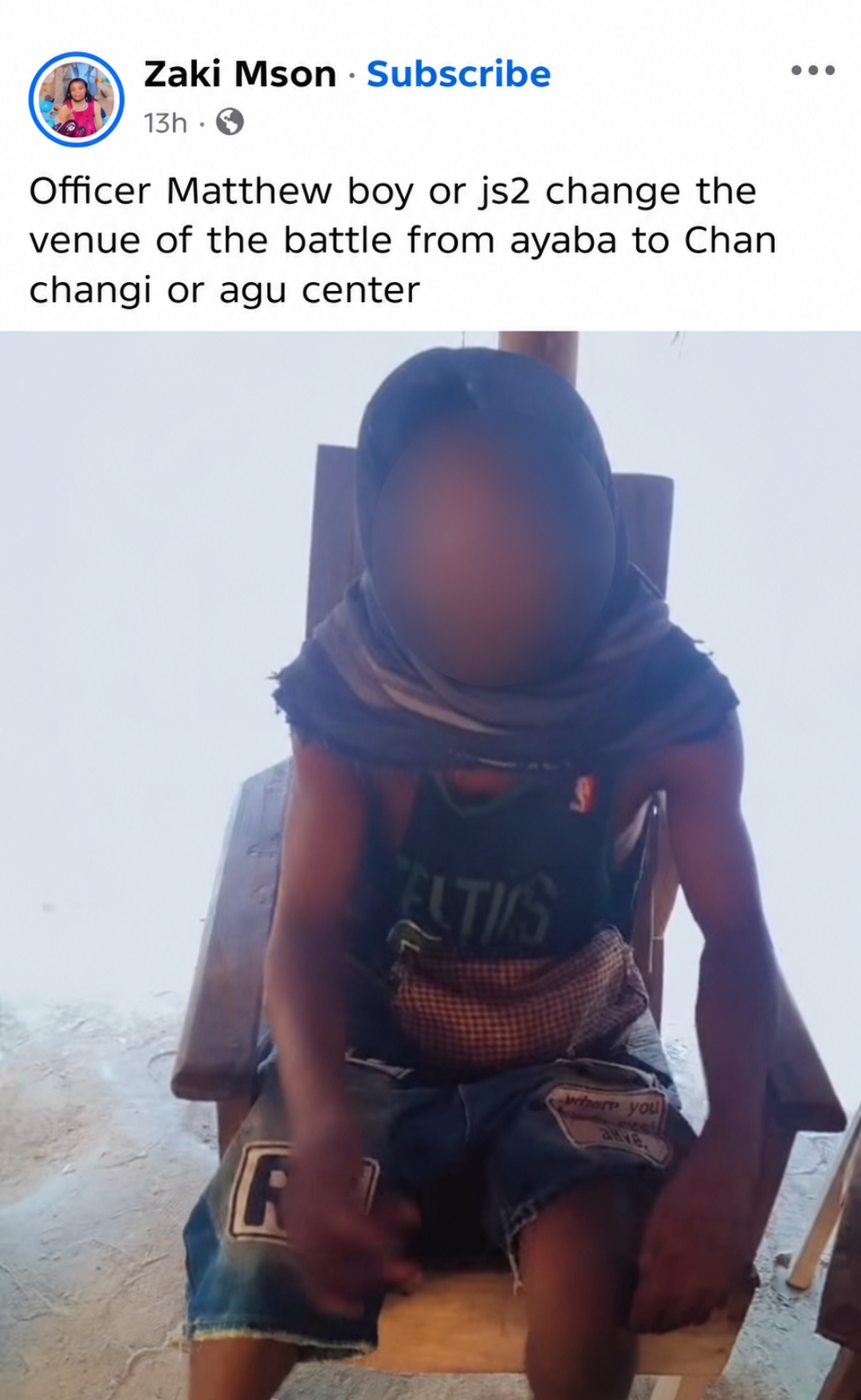
Barely a day before the scheduled Monday encounter, Zegebra and the people travelling with him reportedly decided not to show up at the venue agreed to by the other side. The decision was relayed in a video shared on Facebook by a young man who identified himself as a member of Zegebra’s group and who referred to Zegebra as his “boss.”
In the video, the man said the group could not allow the contest to put its people at risk in Ayaba. According to the speaker, the community “is not a battlefield,” and the fight should instead be moved to Chanchaji or Agu Center, where, he said, Zegebra’s side would “gladly show up.” The speaker also used a belittling phrase to describe Aondongu. Daily Talk has chosen not to repeat that phrase, as it adds nothing to the facts of the story.
The speaker’s argument was that the group’s family members would be made vulnerable if the encounter took place in Ayaba. He did not explain in the video what he meant by “vulnerable,” and he did not say who or what his group feared in the community. Daily Talk could not independently verify the identity of the speaker, or whether he truly speaks for Zegebra.
Aondongu’s original acceptance: “I have chosen Ayaba”
The planned fight began as a public challenge exchanged on social media. Aondongu Peter Suleagbough, who presents himself as a peace crusader working for calm in Sankera, said he had accepted the challenge issued to him and had chosen Ayaba as the venue.
In his own words, he said he had accepted the challenge thrown at him through an officer he named as Zegebra, and had picked Ayaba, “where Zegebra’s parents are currently living.” He added that he would show up, and that if he failed to do so he would give up his cause. If, however, he came and Zegebra failed to appear, Aondongu said, then Zegebra “should stop posting on Facebook.”
That statement set a clear public test: one man promised to be at the place he named, and he challenged the other to do the same. With Zegebra’s camp now saying the venue is unacceptable, the question for many residents is whether the planned contest will be rescheduled, relocated, or abandoned altogether.
Why Ayaba matters in this dispute
By choosing the community where, in his words, Zegebra’s parents live, Aondongu appeared to be making a point about accountability: that the man he was challenging has family and roots in the very place where the contest was to be held. Zegebra’s camp has answered by saying that the same community must not be turned into a battleground.
That argument will not sit comfortably with everyone. Some readers will see it as a reasonable concern for the safety of ordinary villagers. Others will see it as an excuse to avoid a public test. Daily Talk takes no side. What can be said is that a community of families, farmers, traders and schoolchildren should not be placed in harm’s way for the sake of a social media dispute, whatever the venue.
Who are the two men at the centre of the story?
Aondongu Peter Suleagbough
Aondongu describes himself as a peace crusader. Followers of his posts say he speaks out against violence and kidnapping in Sankera and urges young people to stay away from armed groups. Daily Talk has not independently confirmed his background, any organisation he may represent, or the full scope of his activities.
Mson Matthew, a.k.a. Zegebra
Zegebra is the name by which Mson Matthew is widely known in online discussions. He is alleged by many people in the area to be a kidnapping kingpin. It is important to stress that these are allegations. Daily Talk is not aware of any court conviction against him, and nothing in this report should be read as a finding of guilt. Any person named in a news report is presumed innocent unless a court of competent jurisdiction decides otherwise. Zegebra and his representatives are welcome to respond to this report, and any reply will be published.
A note of caution on public “fights” and social media challenges
Public challenges between a self-styled peace advocate and a man accused by locals of serious crime carry real risks. A large crowd, high emotions and, according to residents, the possible presence of armed persons are not a safe mix. Nigerian law places the duty to maintain public order on the police and other security agencies, and private citizens are not authorised to settle disputes through organised combat.
Peace advocates across Benue State have long argued that the surest way to end violence is to encourage dialogue, support community leaders and report criminal activity to the authorities. Residents who see or hear of any planned gathering are advised to stay away from it and to share relevant information with the police or other security agencies through official channels.
Security agencies yet to react
As of the time of this report, the police, the military and the Benue State Government had not issued any statement on the matter. It remains unclear whether the authorities will allow any gathering on Monday, whether they will deploy personnel to the community, or whether they will take steps to prevent any clash that could cause injuries or deaths.
Daily Talk has asked for comment from the relevant agencies and will update this story as soon as responses are received. The silence has led to anxiety in some quarters, with residents wondering whether the community could be sealed off or flooded with security personnel. Such a response is not unusual in Nigeria when a gathering is considered a threat to public peace.
Background: understanding the unrest in the Sankera axis of Benue State
To understand why a social media challenge between two men has drawn so much attention, readers need to know what Sankera has been through. The story is long, and it involves politics, crime, land, youth unemployment and the struggle of ordinary people to farm and trade in peace.
What is Sankera?
Sankera is the name commonly used for three local government areas in the north-eastern part of Benue State: Katsina-Ala, Ukum and Logo. Katsina-Ala serves as the headquarters of the axis. The area borders Taraba State, and dense forests and difficult terrain on that side have long made it hard for security forces to track armed groups. Most of its people are farmers, and the area contributes a great deal to Benue’s reputation as the “Food Basket of the Nation.”
Early years: amnesty and relapse
The current troubles did not begin overnight. According to a report by The Guardian Nigeria, the Benue State Government granted amnesty in 2015 to more than 500 bandits who had been terrorising parts of Benue and Taraba states, among them a man widely known as Gana. The same report said most of those who received amnesty later returned to crime. Gana’s later killing was confirmed by the Defence Headquarters, which described him as the state’s most wanted criminal.
That history shaped the debate that continues today. Supporters of peace deals say talking to armed young men can save lives. Critics say amnesty without strong follow-up, jobs and justice only gives criminals time to regroup.
2020 and 2021: motorcycle ban, curfew and a killing that shook the state
By the end of 2020, the situation had become serious enough for the Benue State Security Council to act. As reported at the time, the council banned the use of motorcycles, popularly called okada, and illegal revenue checkpoints in Katsina-Ala and Ukum local government areas until further notice. Security personnel were told to arrest violators and impound their machines. The reason given was a series of attacks on residents.
The ban was painful for many families because okada riding is a source of daily income for thousands of young men. A group in the area openly complained that the ban had caused hardship, according to a separate Guardian report. The government, however, said the measure was necessary to reduce the mobility of armed groups.
In March 2021, the crisis took a grim turn. Terkula Suswam, a brother of former Benue State Governor Gabriel Suswam, was killed. The state security council then declared what it called total war on criminal elements. As Sahara Reporters reported, a curfew was imposed on the three local government areas, a bounty of N5 million was placed on his killers, and the ban on motorcycles was extended to all three councils. The use of old-model Toyota Corolla cars, said to have been used in criminal operations, was also banned.
Commission of inquiry
The state also set up a judicial commission to look into the causes of the unrest. According to Leadership Newspapers, the commission was chaired by retired Justice Samson Itodo. The same report described Sankera as a hotspot for violent attacks that disrupted farming and trade, and noted that a local government secretariat and an office of the Independent National Electoral Commission in the area had been attacked.
Leadership also reported that rival armed groups, some of them made up of local people, had been attacking and killing residents in several communities. This detail is important: much of the violence in Sankera is blamed not on outsiders but on armed groups from within the area, which makes the problem harder to solve.
2023 and 2024: peace talks, levies and fresh attacks
After Governor Hyacinth Alia took office in 2023, the state government pursued a mix of force and dialogue. In November 2023, the governor’s Special Adviser on Security and Internal Affairs, Joseph Har, told journalists that the government was extending an olive branch to bandits, asking them to “calm down” and working to build back confidence.
The calm did not last. In June 2024, ThisDay reported that suspected bandits had begun collecting taxes and levies from residents of Torough and neighbouring communities in Ukum Local Government Area. Other reports said the chairman of Ukum, Victor Iorzaa, confirmed that a sum of N20 million was being demanded. The governor’s security adviser said then that the bandits were on the run and would not be allowed to collect levies.
Tensions rose further in July 2024. In a broadcast to the people of Benue State on 4 July 2024, Governor Alia said peaceful protests in Ukum had been hijacked by bandits and miscreants who planned to unleash mayhem on businesses and peace-loving residents. A curfew was imposed on Ukum. One month later, a report said thirty people were killed in Ayati village in Ukum on 8 August 2024. That figure comes from a single report and should be treated with caution.
2025: more violence and a rejected peace offer
In April 2025, communities in Ukum and Logo faced what a leading newspaper described as well-coordinated twin attacks. Police statements from that period described a large number of suspected militia moving into communities around Gbagir in Ukum on the night of 17 April 2025. Governor Alia later said local bandits in the three councils had rejected the peace overtures he made to them, according to 21st Century Chronicle.
Even so, the governor has kept calling for dialogue. In a later appeal reported by Leadership, he urged bandits operating in remote areas to come out of hiding and embrace peace. Traditional rulers and political leaders from the area have also joined the calls, and a local peace advocacy group has praised the government’s efforts while condemning fresh attacks.
Why the crisis has been so difficult to end
Security analysts and community leaders often point to several overlapping factors:
- Difficult terrain. Forests along the Benue–Taraba boundary give armed groups places to hide and retreat when security forces advance.
- Youth unemployment. Many young men in rural areas have little work, which makes them easier to recruit into criminal gangs.
- Local involvement. Some groups are made up of local people who know the land and the communities, so it is harder to separate them from ordinary residents.
- Illegal levies and kidnapping. These bring in money that funds weapons and recruitment.
- Weak trust. Residents sometimes fear to share information with security agencies out of concern for their safety.
- Overlapping conflicts. Disputes between farmers and herders and long-running tensions between neighbouring communities add to the instability.
Security agencies, including the joint task force known as Operation Zenda and the military’s Operation Whirl Stroke, have carried out many operations over the years. Police have reported arrests, recovered weapons and killed suspects in gun battles. Yet for many residents the sense of safety remains fragile.
The economic cost to farmers and traders
Insecurity in Sankera has not only cost lives. Farmers in Ukum, Logo and Katsina-Ala have abandoned farmland, and traders have found it hard to move goods safely. A report on the August 2024 killings noted that violence by bandits and local militia has crippled the state’s farming and agro-allied activities and contributed to rising food prices across Nigeria.
For families, the pain is simple: when it is unsafe to go to the farm, there is less to eat and less to sell. Schools lose pupils, clinics lose staff, and young people who see no future become easier targets for recruitment by criminal groups. That is the backdrop against which any peace advocate, including Aondongu, operates.
Politics and the search for solutions
Security in Benue State is also a political issue. As the 2027 elections approach, leaders from every party are being asked what they will do to bring lasting peace to areas like Sankera. Readers who follow the political side of the state can read our report on how Governor Alia has responded to the 2027 power moves in the state.
Whatever the politics, community leaders say a lasting solution will require several things at once: credible intelligence, justice for victims, jobs for young people, respect for traditional institutions, and the courage of citizens to speak out safely. A social media duel cannot provide any of these.
What happens next?
Several possibilities exist. Zegebra’s camp may press for a new venue in Chanchaji or Aug Center, and Aondongu may decide whether to accept. Aondongu may say that his challenge was tied to Ayaba and that the withdrawal speaks for itself. Or the authorities may step in and discourage any gathering altogether. Daily Talk will follow each development.
For now, the most sensible advice for residents is simple: avoid crowds linked to the dispute, do not share unverified videos that could inflame tensions, and give any useful information to the police or other security agencies. Parents should keep children away from any venue linked to the planned encounter.
Frequently asked questions
Who is Zegebra?
Zegebra is the popular name of Mson Matthew, who is alleged by many residents of the Sankera area to be a kidnapping kingpin. The claim is an allegation, and Daily Talk is not aware of any court conviction.
Who is Aondongu Peter Suleagbough?
He is a self-styled peace crusader who accepted a challenge to a public face-off and chose Ayaba as the venue.
Why did Zegebra withdraw?
A member of his group said in a Facebook video that Ayaba “is not a battlefield” and that the fight should be held at Chanchaji or Aug Center instead.
Where is Sankera?
Sankera is the name for the Katsina-Ala, Ukum and Logo local government areas in the north-eastern part of Benue State, close to the boundary with Taraba State.
Have the police or the military reacted?
Not yet. At the time of publication, the security agencies had not commented on whether they would allow any gathering on Monday.
Conclusion: a test for peace, not for muscle
Zegebra’s withdrawal ends one chapter of an unusual public drama, but not the larger story. Sankera has endured years of fear, from the early amnesty and the motorcycle ban to curfews, levies and deadly attacks. Whatever happens on Monday, the people of Katsina-Ala, Ukum and Logo deserve safety, and they deserve leaders on every side who put the lives of ordinary families first.
Daily Talk will continue to report developments from Benue State and across Nigeria. For more local reports, visit our Metro section.
Editor’s note: This report is based on a video and statements circulating on Facebook, which Daily Talk could not independently verify. Individuals named as alleged offenders are presumed innocent unless convicted by a court. Anyone mentioned in this report who wishes to respond may contact the editorial team. If you have information about any planned gathering or criminal activity, please contact the police or other security agencies.


[…] Ichen Flees Into Hiding as Aondongu Plans Ayaba Visit in Ukum Zegebra withdraws from face-off with peace crusader Aondongu, says Ayaba not a battlefield Benue Diaspora in Plateau Endorses Aondoakaa for 2027 Governorship, Pledges Campaign Support Benue […]